

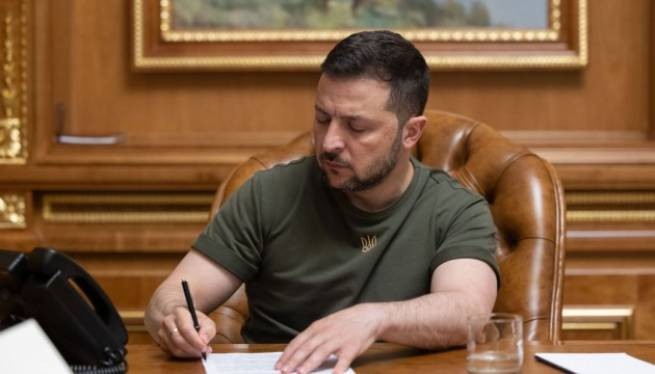
Ukraine’s President Signs Law Banning Russia-Linked Religious Groups
Ukrainian President Volodymyr Zelensky has signed a controversial new law banning religious organizations with ties to Russia, a move that further escalates the deepening rift between Ukraine and its powerful neighbor. The legislation, passed by Ukraine’s parliament, is aimed at severing the influence of Russia-linked religious groups, particularly the Ukrainian Orthodox Church (UOC), which has long been accused of maintaining close ties with the Moscow Patriarchate and supporting pro-Russian narratives.
The Law and Its Implications
The new law prohibits the operation of religious organizations and institutions that are deemed to have connections with or are controlled by Russia. This primarily targets the Ukrainian Orthodox Church, which, despite declaring its independence from Moscow in May 2022, continues to be viewed by many in Ukraine as loyal to Russian interests. The law allows Ukrainian authorities to dissolve religious organizations found to be violating its provisions and to seize their assets.
The legislation represents a significant step in Ukraine’s ongoing efforts to distance itself from Russia, not just politically and economically, but also culturally and religiously. It comes amid the backdrop of Russia’s full-scale invasion of Ukraine, which began in February 2022 and has further intensified nationalistic and anti-Russian sentiments throughout the country.
Proponents of the law argue that it is necessary for national security, citing concerns that Russia-linked religious organizations may serve as conduits for Russian propaganda or even covert operations. Supporters also emphasize that the move is in line with Ukraine’s broader efforts to assert its sovereignty and eliminate any vestiges of Russian influence over its institutions.
Impact on the Ukrainian Orthodox Church
The law will have profound consequences for the Ukrainian Orthodox Church, which has historically been affiliated with the Russian Orthodox Church but has faced increasing scrutiny and suspicion since Russia’s annexation of Crimea in 2014 and the ongoing conflict in eastern Ukraine.
In recent years, the UOC has been accused of harboring pro-Russian sentiments and providing moral support to separatist forces in Ukraine’s eastern Donbas region. Ukrainian security services have conducted raids on UOC churches, monasteries, and properties, citing concerns about the church’s potential role in espionage or undermining Ukraine’s territorial integrity. Some clerics have even been accused of collaborating with Russia during the ongoing war.
The law is expected to further marginalize the UOC, forcing many of its parishes and religious leaders to either sever ties with Moscow completely or face dissolution. This could lead to a realignment of religious affiliations within Ukraine, with more parishes potentially joining the Orthodox Church of Ukraine (OCU), which was established in 2018 and is fully independent of the Russian Orthodox Church. The OCU has emerged as the primary religious institution in Ukraine since receiving formal recognition from the Ecumenical Patriarchate of Constantinople.
Criticism and Concerns
Despite its intentions, the law has faced considerable criticism both domestically and internationally. Religious freedom advocates, human rights organizations, and even some Ukrainian citizens have raised concerns that the legislation could infringe on the rights of religious believers and be used to suppress dissent.
Critics argue that the law could be seen as a violation of the right to freedom of religion, as enshrined in international human rights treaties to which Ukraine is a signatory. They fear that the government could use the law to target religious organizations that are perceived as opposing its policies, even if they are not directly linked to Russia.
The Russian government has also condemned the legislation, describing it as a politically motivated attack on religious freedom. Russian officials claim that Ukraine is persecuting the Ukrainian Orthodox Church and its followers, and have warned that the law could further exacerbate tensions between the two countries.
International organizations, including the United Nations and the Organization for Security and Co-operation in Europe (OSCE), have urged Ukraine to ensure that the new law is implemented in a way that respects religious freedom and does not disproportionately target certain religious communities.
Zelensky’s Justification
President Zelensky, however, has defended the law as a necessary measure to protect Ukraine’s national security during a time of war. In a public statement following the signing of the legislation, Zelensky emphasized that the move was not an attack on religious freedom, but rather a defensive action to prevent any religious organizations from undermining Ukraine’s sovereignty or aiding Russia’s war efforts.
Zelensky’s government has made it clear that religious organizations aztec88 login must support the integrity of the Ukrainian state and reject any associations with Russia, especially amid ongoing hostilities. By cutting ties with Moscow-affiliated religious institutions, Zelensky’s administration hopes to strengthen Ukraine’s unity and independence in the face of Russian aggression.
What’s Next?
The enforcement of the new law is likely to lead to further legal battles, as religious organizations challenge the government’s actions in Ukrainian courts and potentially in international forums. The long-term impact on Ukraine’s religious landscape remains uncertain, but the law is expected to accelerate the shift toward a more independent, Ukraine-focused religious identity.
For now, the law represents another front in Ukraine’s ongoing struggle to defend its sovereignty against Russian influence, even as the war rages on. It highlights the increasingly complex relationship between religion, politics, and national security in a country that is fighting not just for its territory but also for its cultural and spiritual independence.