

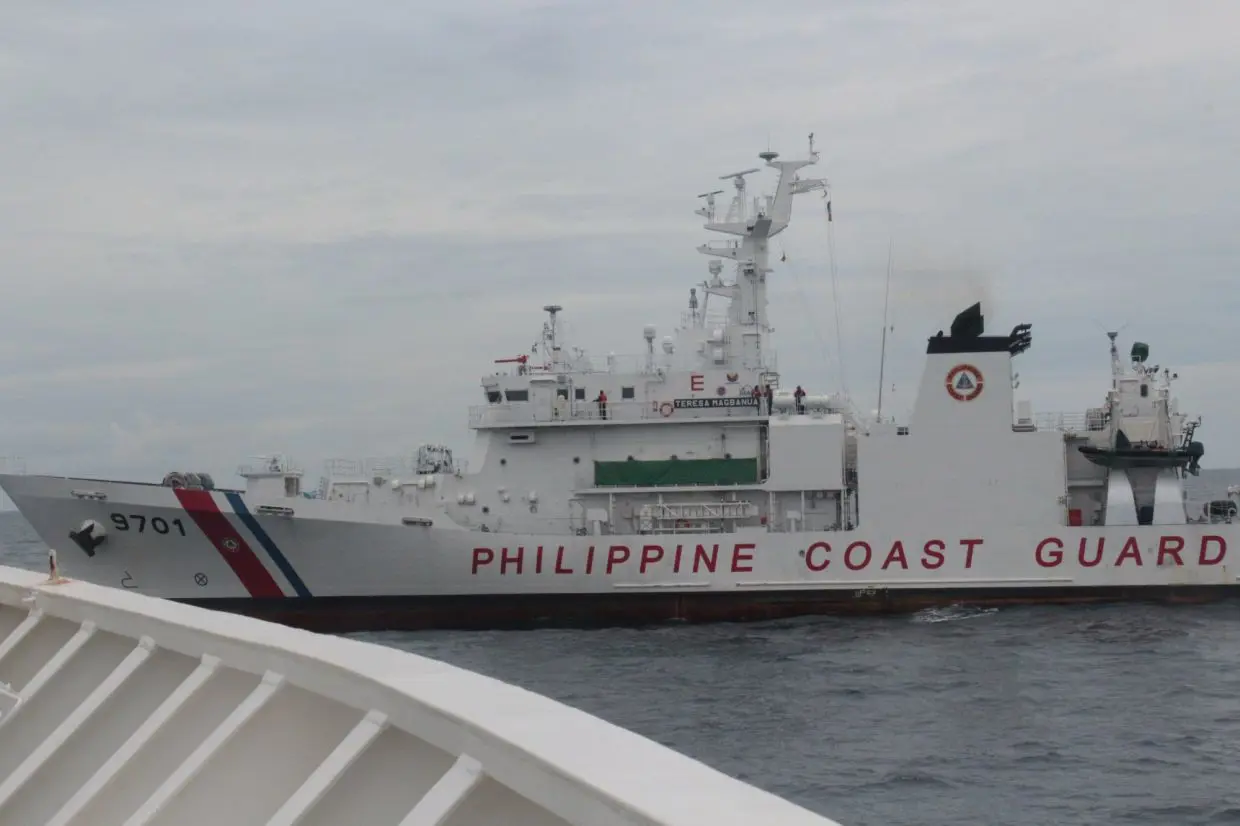
Beijing has strongly opposed the Philippines’ new maritime law, which it claims infringes upon its sovereignty over disputed territories in the South China Sea. The new law, passed by the Philippine government in 2024, aims to assert the country’s rights over vast portions of the South China Sea, a region rich in natural resources and strategically vital for global shipping routes. In response, China has reiterated its stance on the South China Sea, vowing to safeguard what it considers its “sovereignty” over the contested waters.
The Philippine government’s move to formalize its maritime claims has sparked tension in a region already fraught with geopolitical disputes. The South China Sea is one of the most contested waters in the world, with China, the Philippines, Vietnam, Malaysia, and Brunei all laying claim to various parts of the sea. China’s claim, based on historical maps, is represented by the “nine-dash line”, which encircles most of the South China Sea and overlaps with the exclusive economic zones (EEZ) of several Southeast Asian nations.
The Philippine Maritime Law: A Bold Move
In late 2024, the Philippine Congress passed a landmark maritime law designed to assert Philippine sovereignty in the South China Sea. The law establishes clearer guidelines for Philippine waters, particularly around the Spratly Islands, a group of islands and reefs also claimed by China. Under this new legislation, the Philippines intends to reinforce its Exclusive Economic Zone (EEZ) and continental shelf, extending its jurisdiction over fisheries, energy exploration, and maritime patrols in areas that Beijing claims.
The law also creates a new National Coast Guard agency tasked with securing the country’s maritime interests in contested waters. This includes the deployment of vessels and personnel to patrol areas deemed to be under Philippine jurisdiction, despite China’s claims. Furthermore, the law enhances cooperation with international allies, notably the United States, in conducting joint military exercises and ensuring freedom of navigation in the region.
“We have passed this law to protect our sovereignty, resources, and the safety of our maritime domain,” said Philippine President Ferdinand Marcos Jr. after the law’s enactment. “We are committed to ensuring that the rights of our people are respected.”
China’s Response: A Firm Stance on ‘Sovereignty’
In response to the Philippines’ new maritime law, China has issued a formal statement condemning the legislation. Chinese officials have expressed strong opposition to any measures that challenge China’s territorial claims in the South China Sea, and reiterated their position that the nine-dash line is legally valid, despite international rulings to the contrary.
A spokesperson for the Chinese Ministry of Foreign Affairs stated, “China has indisputable sovereignty over the South China Sea, including the Spratly Islands and their surrounding waters. We firmly oppose any action by other countries that attempts to undermine this sovereignty.”
China’s statement further emphasized that it would take all necessary measures to defend its maritime rights, including enhancing its military presence in the region. The country has increasingly militarized its claimed territories, constructing artificial islands, deploying radar and missile systems, and stationing naval forces to assert control over the waters.
“China will protect its territorial integrity and maritime interests with all means available,” the statement concluded.
The Geopolitical Implications
The introduction of the Philippine maritime law and China’s reaction are likely to intensify the already volatile geopolitical dynamics in the South China Sea. The sea is a critical waterway for global trade, with over $3 trillion worth of goods passing through it annually. It is also believed to hold significant reserves of oil and natural gas, making it a hotspot for resource extraction and economic interests.
Several Southeast Asian nations, including Vietnam and Malaysia, have also expressed concerns over China’s expanding influence in the region, particularly its construction of military installations on artificial islands. The United States has been a vocal supporter of the Philippines and other claimant countries, advocating for the maintenance of freedom of navigation and opposing China’s excessive territorial claims.
The Philippines has long been an ally of the U.S., and the two countries have conducted joint military exercises in the South China Sea to strengthen defense ties. The U.S. has reiterated its commitment to defend the Philippines under the terms of the Mutual Defense Treaty, should its forces or assets be attacked in the region.
China’s growing assertiveness in the South China Sea has drawn condemnation from the international community, including the United Nations. In 2016, an international arbitral tribunal ruled in favor of the Philippines, rejecting China’s claims to the nine-dash line. However, Beijing has dismissed the ruling and continued its activities in the region.
The Role of International Law
The Philippines’ new maritime law is a significant step in its efforts to assert its territorial rights within the framework of international law. The country has long relied on the United Nations Convention on the Law of the Sea (UNCLOS) to support its claims to areas within its EEZ. The law passed by the Philippine Congress aims to align the country’s maritime policies with UNCLOS, which recognizes the rights of coastal nations to explore and exploit natural resources within 200 nautical miles of their shores.
While China disputes the interpretation of UNCLOS, many other countries, including the U.S. and Japan, have supported the Philippines’ legal standing in the dispute. The U.S. has called for all parties to adhere to international law in resolving the South China Sea issue and has urged China to respect the 2016 ruling, which declared China’s claims to the region unlawful.
Rising Tensions: A Delicate Balance
The situation in the South China Sea remains fraught with tensions. The Philippines’ new maritime law could lead to more confrontations between Chinese and Philippine vessels, as well as an escalation of military activities in the region. Both countries have a history of naval standoffs, particularly around the Scarborough Shoal and the Spratly Islands.
In recent years, China has sought to leverage its growing economic and military power to solidify its influence in the region, while the Philippines has been increasingly looking to international partners to counterbalance Beijing’s assertiveness.
The growing tensions underscore the need for a diplomatic resolution to the South China Sea dispute, one that respects the rights of all claimant nations and ensures regional stability. However, with both China and the Philippines firmly entrenched in their positions, the possibility of a peaceful compromise remains uncertain.
Conclusion: A Complex and Evolving Dispute
The Philippines’ new maritime law marks a significant chapter in the ongoing South China Sea dispute, reflecting the country’s determination to assert its territorial rights in the face of China’s expanding influence. For China, the law represents yet another challenge to its claims, and Beijing’s vow to protect its sovereignty signals a potential for further geopolitical tensions.
As both nations navigate this complex issue, the international community will be watching closely, hoping that diplomacy and adherence to international law can prevail to prevent a larger confrontation. The South China Sea remains a geopolitical flashpoint, and the resolution of the competing claims will have long-lasting implications for regional security and global trade.